IAT 2026 Exam Day Guide: Documents, Strategy & Final Week Preparation
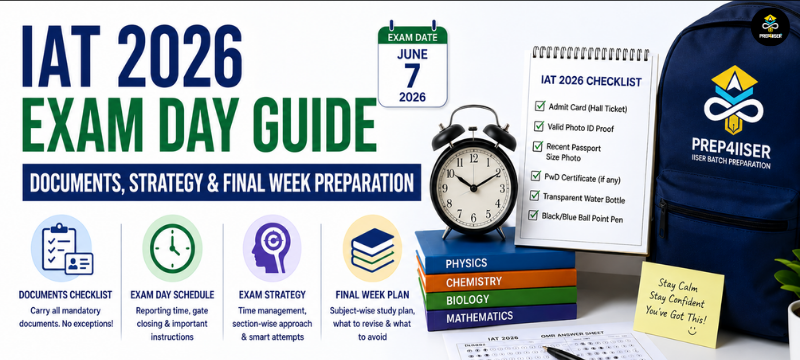
Exam Date: June 7, 2026 | Mode: Computer-Based Test (CBT) | Duration: 3 Hours
Who This Guide Is For: IAT 2026 candidates in the final days before the examination. This guide covers every mandatory document, the exact reporting schedule, exam hall protocols, and a complete subject-wise preparation strategy for the remaining time.
Official Portal: iiseradmission.in
With the IISER Aptitude Test on June 7, 2026, the priority now shifts from covering new ground to executing cleanly on what you already know. This guide addresses both dimensions: what to carry to the exam centre, and how to use the final days most effectively.
IAT 2026 at a Glance
| Feature | Details |
|---|---|
| Conducting Body | IISER Berhampur (for 2026) |
| Exam Date | June 7, 2026 |
| Mode | Online Computer-Based Test (CBT) |
| Total Questions | 60 MCQs (15 per subject) |
| Marking Scheme | +4 correct / −1 incorrect / 0 unattempted |
| Total Marks | 240 |
| Subjects | Physics, Chemistry, Mathematics, Biology |
| On-Screen Calculator | Provided (non-programmable); personal calculators not allowed |
| Official Website | iiseradmission.in |
Part 1: Exam Day Complete Protocol and Requirements
Reporting and Timing Schedule
Late arrival is the one error with no recovery option. Plan your journey the evening before: check the route, estimate travel time with a realistic buffer, and identify parking or drop-off logistics. Large test centres process hundreds of candidates in the same window, and queues move slower than expected.
| Time | Event |
|---|---|
| 7:00 AM | Reporting begins at the test centre |
| 8:30 AM | Gates close entry not permitted after this point |
| 8:30 – 8:50 AM | Document verification, biometric registration, frisking |
| 8:50 – 9:00 AM | System login and on-screen instruction reading |
| 9:00 AM | Examination begins |
| 12:00 PM | Examination ends |
Candidates should be at the centre by 7:15–7:30 AM. PwD candidates receive priority entry. All other candidates should factor in additional processing time at high-volume centres.
Mandatory Documents Checklist
Every item listed below is required. Missing any one of them particularly the Hall Ticket or a valid original photo ID may result in denial of entry. Prepare and pack these the night before.
1. IAT 2026 Admit Card (Hall Ticket)
- Print in colour on A4-size paper. A laser printer is preferable; inkjet printouts must have clear, sharp reproduction of the photograph and signature.
- Verify that your photograph and signature are legible before leaving home. Smudged, faded, or unclear printouts have caused verification issues at centres in previous years.
- Paste a recent passport-size photograph at the designated space on the printed Hall Ticket before arriving.
- Carry two copies. One copy will be retained at the examination hall; the second is yours to keep.
2. Original Photo ID with Photocopy
The following documents are accepted as valid photo identification. The document must be original (not expired) and accompanied by a photocopy:
- Aadhaar Card (UID)
- Voter ID Card
- Passport
- PAN Card
- Driving Licence
- Nationalised Bank Passbook with photograph
- Class 10 or Class 12 Marksheet, Certificate, or Admit Card with pasted photograph
The name on the identity document must match the name on the Hall Ticket exactly. Discrepancies including spelling variations can cause delays at verification.
3. PwD Certificate (if applicable)
PwD candidates must carry both the original certificate and a photocopy. Presentation of the original certificate is required to access entitlements including priority entry, scribe, or compensatory time as applicable under the candidate's specific disability category.
What to Carry into the Examination Hall
| Item | Requirement |
|---|---|
| Hall Ticket | Colour printout, A4, photograph pasted |
| Original Photo ID | Valid, unexpired government or board-issued document |
| Ball-point pen | For signing documents and rough sheets inside the hall |
| Transparent water bottle | Allowed inside |
Items Strictly Not Permitted
The following items must not be brought to the examination centre. There is no facility to store personal belongings outside the hall any prohibited item must be left at home or in a personal vehicle:
- Mobile phones, smartwatches, or any electronic wearable device
- Personal calculators of any type a non-programmable on-screen calculator is provided
- Metallic jewellery or accessories that may trigger the frisking process
- Personal rough paper official rough sheets are provided inside and must be returned to the invigilator after the examination
- Accompanying persons family members or friends are not permitted on the examination premises
Inside the Examination Hall
Candidates receive printed rough sheets for calculations. Write your name and application number on each sheet before beginning the examination. All rough sheets must be submitted to the invigilator at the conclusion of the test.
The on-screen calculator is non-programmable and is provided on every workstation. Do not bring a personal calculator under any circumstances.
The examination interface is identical to the one used in IAT mock tests on the official portal. Candidates who have not yet done so should complete at least one session on the official IAT 2026 mock test before exam day to avoid interface unfamiliarity during the actual examination.
Communication with other candidates during the test verbal or otherwise is grounds for immediate disqualification.
Part 2: Final Week Preparation Strategy
The examination is on June 7. The days remaining are not for covering new syllabus they are for consolidating, testing, and sharpening what you already know.
Step 1: Understand the Paper Structure Precisely
IAT 2026 tests conceptual depth across four subjects in equal proportion. Every subject carries exactly 15 questions and 60 marks.
| Subject | Questions | Maximum Marks |
|---|---|---|
| Physics | 15 | 60 |
| Chemistry | 15 | 60 |
| Mathematics | 15 | 60 |
| Biology | 15 | 60 |
| Total | 60 | 240 |
No subject can be deprioritised. In a 60-question paper, consistent performance across all four subjects is what separates competitive ranks from borderline ones. Even a student with a weak Biology background can improve their rank meaningfully by targeting 5–6 correct answers in that section rather than abandoning it entirely.
Step 2: Concentrate Revision on High-Yield Topics
With limited time available, the most effective use of the remaining preparation hours is focused revision of topics with historically high question frequency. The following selection is based on observed IAT question patterns:
Physics
- Modern Physics: photoelectric effect, atomic models, radioactive decay, nuclear binding energy
- Current Electricity: Kirchhoff's laws, resistor networks, RC circuits
- Thermodynamics: laws of thermodynamics, Carnot cycle, entropy
- Ray Optics: lens and mirror equations, refraction, total internal reflection
- Laws of Motion and Work-Energy Theorem
Chemistry
- Chemical Bonding: VSEPR theory, hybridisation, molecular orbital theory
- Organic Reaction Mechanisms: SN1 and SN2 substitution, electrophilic addition, elimination reactions
- Electrochemistry: electrode potential, Nernst equation, Faraday's laws of electrolysis
- Coordination Compounds: nomenclature, isomerism, crystal field theory, CFSE
- Chemical Thermodynamics: Hess's law, Gibbs free energy, spontaneity
Mathematics
- Calculus: limits, differentiation, integration, definite integrals, applications
- Probability: conditional probability, Bayes' theorem, probability distributions
- Coordinate Geometry: conic sections, area using integration, distance and section formulae
- Matrices and Determinants: properties, inverse, system of equations
- Functions: types, composition, inverse functions, domain and range
Biology
- Genetics: Mendel's laws, chromosomal linkage, crossing over, mutation
- Human Physiology: digestive, circulatory, neural, and excretory systems
- Molecular Biology: DNA replication, transcription, translation, central dogma
- Ecology: ecosystem structure, food chains, population dynamics, biogeochemical cycles
- Biotechnology: PCR, gel electrophoresis, recombinant DNA technology, ELISA
Step 3: Use Condensed Revision Material, Not Full Chapters
Reading complete chapters in the final week has diminishing returns. The objective at this stage is recall reinforcement, not first-time learning. Use the following format instead:
- Formula summary sheets for Physics and Chemistry single page per subject
- Organic reaction mechanism charts covering the named reactions most likely to appear
- Biology terminology cards or a structured table covering molecular biology and physiology keywords
- Short notes compiled during preparation these reflect exactly what you found non-obvious and are more useful than any standard reference
- Topic-wise MCQ practice on PREP4IISER to test active recall, not passive recognition
If condensed notes do not yet exist, spend one session today creating a single A4 revision sheet per subject containing the formulas, reactions, and definitions you are most likely to confuse under timed pressure.
Step 4: Solve Previous Year IAT Papers Under Timed Conditions
This is the most productive use of remaining days. IAT previous year papers provide several advantages that topic-wise practice cannot:
- They establish the actual difficulty level of IAT questions, which is more conceptual and less calculation-heavy than JEE
- They reveal which topics appear in nearly every paper without exception
- They expose the structure of IAT answer options distractors are designed around common conceptual errors, not random choices
- They calibrate realistic time allocation across subjects under actual exam conditions
Solve at least one complete paper per day in a strict 3-hour sitting. After each paper, review every incorrect answer not only questions flagged as uncertain, but also questions answered correctly through guessing. Understanding why a wrong option seems correct is as valuable as knowing why the right option is right.
Step 5: Use Mock Tests for Performance Calibration
Mock tests in the final week serve a different function than they did during early preparation. The objective now is not to discover new weak areas it is to calibrate execution.
Use each mock session to:
- Establish a reliable time allocation per subject. A target of approximately 40–42 minutes per subject is reasonable; adjust based on your subject-specific speed
- Identify question types where you consistently lose time disproportionate to the marks available
- Practice the question triage approach: read through the section quickly, answer straightforward questions first, flag uncertain ones, and return systematically
- Build mental stamina for sustained 3-hour focus, which is itself a trainable skill
Allocate as much time to post-mock analysis as to the mock itself. An unreviewed mock test is a wasted one.
Step 6: Apply a Disciplined Approach to Negative Marking
IAT awards +4 for a correct answer and deducts 1 mark for an incorrect MCQ response. Random guessing produces a negative expected value. However, informed guessing based on partial elimination produces a positive expected value and should be applied as a systematic strategy rather than avoided entirely.
Decision framework for each attempted question:
- Able to eliminate two of four options: the expected value of attempting is positive. Attempt the question.
- Able to eliminate one of four options with a strong inclination toward one of the remaining three: attempt, provided the leaning is genuine and not arbitrary.
- Unable to eliminate any option and no informed basis for a preference: skip. Zero marks is superior to −1.
Numerical Answer Type (NAT) questions carry no negative marking. Every NAT question should be attempted regardless of certainty, since an incorrect numerical response costs nothing.
A separate and equally important discipline is not skipping questions on the basis of apparent difficulty before reading them carefully. IAT occasionally presents questions with complex-looking setups that reduce to a single-step insight once parsed. Skipping on appearance is a recoverable error only if time permits a return; skipping without reading is an unforced loss.
Step 7: The Day Before the Examination June 6
The evening of June 6 requires a specific approach. The goal is mental readiness, not additional content coverage.
Recommended actions:
- Complete a light 30-minute pass through your formula sheets. Do not read new material or open a new chapter.
- Pack your bag with the complete documents checklist: Hall Ticket (two colour copies, photograph pasted), original photo ID, photocopy of ID, ball-point pen, and water bottle.
- Confirm the exact location of your test centre on Google Maps. Drive or commute the route mentally, accounting for morning traffic. Add a 30-minute buffer beyond your estimated travel time.
- Set two alarms for the morning. Target lights out by 10:30 PM.
Actions to avoid:
- Solving a new mock test in the evening this creates performance anxiety without providing meaningful revision value
- Attempting to cover unfamiliar material in the belief that a new topic might appear
- Spending time on social media comparing preparation levels with other candidates
Sleep is a direct performance variable. Seven to eight hours before a high-stakes examination produces measurable improvements in information retrieval, calculation speed, and decision quality.
Step 8: Examination Morning June 7
Wake up at your planned time, eat a light and familiar meal, do a single brief pass through your formula sheets, and leave for the centre with adequate time to spare.
Do not experiment with food choices on exam morning. Avoid heavy or greasy meals that cause sluggishness. Hydrate normally.
At the examination centre, avoid conversations about expected topics or mutual comparisons of preparation coverage. Your preparation is complete. The time remaining before the examination begins is most productively spent in calm mental preparation, not in last-minute anxiety calibration with other candidates.
Subject-Wise Final Preparation Notes
Physics
IAT Physics rewards problem-solving fluency over formula recall. When a question is unclear, drawing a diagram for mechanics, optics, or circuit problems typically reveals the solution path. For Modern Physics, the energy-wavelength-frequency relationships and their applications should be automatic. A candidate who can visualise the physical setup of a problem is at a structural advantage over one who works only from memory.
Chemistry
Organic reaction mechanisms represent a reliable high-yield area in every IAT paper. The distinction between SN1 and SN2 conditions, Markovnikov and anti-Markovnikov addition, and the factors governing E1 versus E2 elimination should be thoroughly clear. For Inorganic Chemistry, coordination compound nomenclature and Crystal Field Stabilisation Energy values are standard appearance topics. Note that thermodynamics spans both Chemistry and Physics in IAT preparation in this area yields proportionally high returns.
Mathematics
IAT Mathematics questions frequently have elegant short solutions that are not immediately obvious from the problem setup. A calculation that becomes unwieldy is usually a signal that a simpler approach substitution, symmetry, or a standard result has been missed. In the final days, practise recognising these shortcut triggers rather than solving by brute force. Definite integral and probability problems tend to consume disproportionate time; flag and return to them if they resist an initial approach.
Biology
Biology is the section where PCM-dominant candidates most frequently underperform without cause. The section is substantially NCERT-aligned and rewards systematic revision disproportionately compared to the preparation time it requires. Two focused sessions on Genetics (Mendelian and molecular) and Human Physiology are sufficient to produce competitive scores in most cases. Molecular Biology particularly the central dogma, replication enzymes (helicase, primase, DNA polymerase, ligase), and translation mechanics should be known with precision.
Examination-Day Strategy Framework
| Phase | Recommended Approach |
|---|---|
| First 5 minutes | Read all on-screen instructions before beginning |
| Subject order | Begin with your strongest subject to establish early momentum and confidence |
| Per question | Target 90 seconds average; move on if a question does not yield an approach quickly |
| Mid-examination | Use the flag feature for uncertain questions; do not linger |
| Last 15 minutes | Return to all flagged questions; complete a full review of responses |
| Final minute | Do not revise answers unless there is a specific and clear reason to do so |
Common Errors to Avoid on Exam Day
The following mistakes are entirely preventable and have affected candidates in previous IAT cycles:
- Bringing a personal calculator not permitted under any circumstances; the on-screen calculator is sufficient for all required calculations
- Arriving after 8:30 AM the gate closes at 8:30 AM without exception; plan to arrive by 7:15–7:30 AM
- Omitting the photograph on the Hall Ticket printout the photograph must be pasted before arriving at the centre
- Printing the Hall Ticket in black and white the Hall Ticket must be printed in colour on A4 paper
- Abandoning a question on the basis of initial difficulty IAT questions that appear intimidating on first reading sometimes resolve quickly once parsed carefully
- Revising correct answers during the final review without a specific, evidence-based reason second-guessing under time pressure typically reduces scores
Frequently Asked Questions
Can I use my own calculator during IAT 2026?
Do I need to print the Hall Ticket in colour?
How many copies of the Hall Ticket should I carry?
What photo ID documents are accepted at IAT 2026?
What is the last time I can enter the examination centre?
Is there rough paper provided, or should I bring my own?
Should I attempt all 60 questions?
Which subject should I attempt first in IAT 2026?
What should I do if I encounter a very difficult question?
Where can I access the official IAT 2026 mock test interface?
Post-Examination: What Happens Next
Once the examination concludes on June 7, the following timeline applies:
Response Sheet (TCS iON): Official response sheets are typically released within 24–48 hours of the examination on the TCS iON platform, accessible via the iiseradmission.in portal. Once released, candidates can use the PREP4IISER IAT 2026 Score Calculator and Rank Predictor to calculate their exact subject-wise score and estimated rank before official results are declared.
Official Result: The IAT 2026 result is declared on the official portal along with the All India Rank (AIR) and category rank.
JAC Counseling: Admission through IAT 2026 proceeds via the Joint Admissions Committee (JAC) counseling process, which has historically run across multiple rounds (IAT 2025 had 9 rounds). Candidates should prepare their IISER preference order using previous-year closing rank data available on PREP4IISER.
Disclaimer: This guide is prepared by the PREP4IISER editorial team based on official IAT documentation and historical exam patterns. It is not affiliated with the IISER Joint Admissions Committee (JAC) or any official body. Always verify procedural requirements at iiseradmission.in before examination day.
Published: June 2026 | PREP4IISER Team